Sunday, April 28, 2013

Villas and Grottos and Monsters, Oh My!

We're in the midst of a holiday season here in Rome.  First, last Sunday (April 22nd) it was Rome's 2766th Birthday (complete with parades in the street), last Thursday (April 25th) it was Liberation Day (where Italy celebrates being liberated from the Fascists at the end of WWII), and next Wednesday (May 1) is International Workers Day (basically the equivalent of Labor Day in the US).  A lot of Italians take the week between Liberation Day and Worker's Day off  of work, so between that, the warmer weather, and increased numbers of tourists, Rome has been feeling a bit too crowded lately!

The Town of Caprarola
Fortunately, on Friday Tom and I got the chance to get out of town on an Academy sponsored day-trip in Northern Lazio. Lazio is also the region of Italy that Rome is in, but when you get even 15 miles out of town, it feels like a different world.  So, by the time we were an hour and a half out of Rome (near Viterbo) we were basically out in the country in a land full of green rolling hills, dense forests, and cute little Medieval towns.

Our trip had three major stops:  Villa Farnese, Villa Lante, and, finally, Sacro Bosco (otherwise known as "Park of the Monsters"). Despite the gloomy weather, each place was absolutely spectacular in its own way.

Arial Shot of Villa Farnese (from internet)
In visiting the sites in this order, we moved from places that were more focused on indoor space (that perhaps flaunted the owner's wealth and power), to space that was focused on the outdoors and a connection with nature.  So, the main attraction our first stop, Villa Farnese, was the beautiful villa itself.

In the early 1500s, Cardinal Alessandro Farnese (who later became Pope Paul III), commissioned the building of a fortress, which was also used as a summer estate for the Farnese family.  The building was designed in a pentagon shape, with its rooms situated around a circular courtyard.

Each room of the Villa was enormous, and was covered with beautiful wall and ceiling paintings, often corresponding with the room's use.  (A room used as a bedroom might be filled with dream-like images, for example.)  Many rooms walked out to balcony space around the courtyard, and beautiful giant spiral staircases connected the building's different levels.  Although absolutely stunning, the Villa was perhaps bit too large and ornate for my personal tastes, but I'm pretty sure that Tom is already making plans to move in.

Inside the Villa Farnese
Ceiling of Spiral Staircase 
The Circular Courtyard

But wait... There's more!  Outside, the Villa Farnese has both "lower" and "upper" garden areas (separated by a 5 minute uphill hike).  Even though the gardens seem a bit like an afterthought to the building, they were still equally spectacular, filled with sculptures, fountains, and maze-like garden spaces.

Upper Gardens
Spitting Sea Creature and Garden Maze
More Fountains

Lower Gardens and Casini
Our second stop, Villa Lante, was my favorite location of the day.  Although it was also used as a country estate in the 1500s, the huge outdoor gardens overshadow the physical structures, and encourage outdoor living.  The indoor living space actually consisted of two casini ("little houses"), which are symmetrically situated on either side of the gardens.  

The gardens themselves are situated over several different levels, with each area having its own (but interconnected) water feature and distinct feel.  The lower gardens consisted of hedges sculpted into decorative patters, large ponds, and a beautiful central fountain.  The small second level of the gardens house the large circular Fontana dei Lumini ("Fountain of Lamps), whose jets were designed to look like the flames of oil lamps.  The next level contains a long stone table with a central water channel to keep bottles of wine cool, and the upper levels have additional fountains, and finally a (very mossy) grotto.

Gardens and Fountain
Pond Sculpture
Fontana dei Lumini
Table With Water Channel
More Fountains!
Mossy Grotto
View From the Third Level

Unfortunately, we only had about an hour to walk around the Villa Lante gardens, but I easily could have stayed the entire day- or a lifetime for that matter.  I used the think that the lifestyle of the rich and famous didn't appeal to me (with it's big stuffy mansions with endless rooms filled with uncomfortable furniture), but if I could trade that big mansion in for fancy gardens, I think it would suit me just fine!

Monster in Sacro Bosco
Our last stop of the trip, the Sacro Bosco ("Sacred Woods"), is a large wooded park, containing dozens of oversized statues carved out of the rock. This park, which was originally created in the 1500s, was rediscovered in the late 1800s, and turned into a privately run tourist attraction shortly thereafter.

Because the original pathways are now lost, there's no clear information on what order the statutes were intended to be viewed in, and it's not even clear what the purpose of the space was.  Theories range from the park being a place to philosophically contemplate life  (most of the sculptures are inscribed with thought provoking riddle-like phrases) to being a tribute to the owner's late wife (nevermind the fact that the owner had dozens of mistresses).

Giant Turtle!
Whatever, the purposes, though, it's still a lot of fun (in a Disneyland-esque way) to stroll around the woods and locate all of the crazy statues.  They had everything from giant turtles, to Hercules, to (my personal favorite) the face of a giant monster whose mouth you can walk inside of.

The park also contained a playhouse of sorts that was built at a huge slant so that walking around inside was completely disorienting.  When attempting to stand "straight" you'd actually be leaning at a huge angle, and so moving around was either really fun or completely nauseating (depending on your personal opinion).  

Crooked House 
Me (looking awkwardly scared)
Tom (doing his best Hercules impression- it may need some work)

On days like this one, I feel especially lucky to be part of the Academy community.  Without it, we would likely have never made it to these wonderful sites (since you need a car to get there), and we definitely wouldn't have had the chance to visit these places with so many knowledgeable and fun people.  I don't often post photos of/with these other people (since I don't know who would object to having their photo online), but we really have gotten to know so many fantastic people this year.   Sadly, some of these people will be leaving the Academy as soon as early June, but, as we prepare for our community pizza party and movie night this sunny Sunday afternoon, I'm going to continue to live in denial that any of us ever have to return to the real world!

Alla Prossima,
Erin

--------
Sun. April 28:  The last few days have been cold(er) and rainy, but today is looking beautiful.  We're expecting sun and temps in the 70s all week.

Monday, April 15, 2013

Day Trip to Orvieto: A Tale of Two Wells

Spring is definitely in full-force here in Rome.  Birds are chirping, flowers are blooming, our dinner plates are filled with fava beans and asparagus, and I've officially switched out my raincoat and boots for skirts and sandals.  I'm even writing this blog entry from the Academy's sunny 4th floor terrace.  Still, as wonderful as this is, the arrival of spring has been bitter-sweet, because it feels a bit like the beginning of the end.  I know, I know, woe is me.  I don't expect your sympathy, but (as much as I miss our family and friends) the idea of coming back to "real life" this fall still makes me a bit sad (especially since lucky Tom will get to spend a good chunk of next year in Italy again as a fellow at the Scuola Normale in Pisa).

Orvieto (the old town is up on the hill in the background)
Of course, though, I still have a lot to look forward to, and Tom and I are making a good effort to get some more sight seeing in this spring before it gets unbearably hot (which we hear happens in July and August).  With that in mind, we decided to a take a day-trip up to Orvieto yesterday.  

Orvieto is a small hill-top town located in the Umbria region of Italy, about 75 miles North of Rome.  Unfortunately, like many quaint little Italian towns, it's become a mecca for tourists (especially since a round-trip train ticket from Rome is only about 15 Euros), but it's definitely still possible to appreciate its charm (especially if you're willing to walk a bit off the beaten path).   

Fun on the Funicular
To be more specific, though, I should say that in modern times Orvieto actually consists of both the "new" part (located at the base of the hill, down by the train station), the old city up on the hill.  To get between them, Orvieto's 20,000 residents and countless visitors just need to take a quick one minute ride on the the surprisingly smooth and quiet funicular (which is basically a cable car). And the old city is actually quite old. Although many of the current structures are Medieval, Orvieto began as an Etruscan settlement, and then became part of the Roman Empire around 300 B.C.  After the fall of the Empire, it remained relevant due to its location between Rome and Florence, and (perhaps for that same reason), it remains a popular spot today.    

Typical Orvieto View
Orvieto's biggest claims to fame are probably its Duomo, its 14th century well, and its overall "character," meaning picturesque streets and amazing views of the surrounding countryside.  There are, of course, some museums and a few other points of interest, but given our short visit, Tom and I spent most of the day just walking around town, admiring the architecture, and taking in those amazing views.  Oddly, the square around the Duomo was swarming with tourists, but we practically had the park with the scenic overlook to ourselves.  I haven't spent much time in Tuscany (other than a few days in Florence), but I imagine the landscape is similar to the kind that all of those movie and book heroines seek out when they flee to Tuscany to recover from a bad breakup/find themselves/meet a cute Italian guy (in that order).  And who can blame them?  After spending half an hour gazing out to the variously colored and textured plots of land, I didn't have a care in the world (other than, maybe, where to get my next gelato fix).

Rooftops
Cool Architecture
Views of the Countryside
Me (right) and the Castle Tom Plans to Buy (left)
Duomo

Pozzo della Cava
Perhaps the funniest part of our trip, though, was our attempt to see the famous Orvieto well.  Tom and I didn't have a guidebook (or a map) with us, so we primarily relied on tourist signs (and our bad senses of direction) to get around town.  We had both seen pretty incredible pictures of an Orvieto well, so when we saw signs pointing toward the "Pozzo della Cava," (meaning "well of the cave"), we assumed that was it.  So, we paid the entry fee, and began the self-guided tour. The caves themselves were interesting to see, since many of them were part of an underground system built by the Etruscans, and we were surprised that we practically had the site to ourselves.  When we got to the well, though, it looked much different than we were expecting.  I mean, it was nice enough to look at, and was very deep (which was impressive, considering that at least part of it built in ancient times), but it was lacking the symmetry and windows we were expecting. Still, we thought it was possible that we were just misremembering things, and Tom even suggested that the picture we saw was photoshopped.  After all, we were at the Orvieto well.   

Pozzo di San Patrizio
Still, just to be safe, I skimmed through a guidebook at the Pozzo della Cava gift shop on our way out, and learned that Orvieo actually has not one- but two- tourist sites involving wells.  Honestly, what were the chances?!  So, Tom and I made our way to the other side of the hill to visit the other one, Pozzo di San Patrizio.  This well, which was built in the 1500s, turned out to look exactly how we had imagined it.  It housed two internal spiral staircases (one for going up, one for going down), and was full of windows (and tourists).  The water only exists at the very bottom of the 175 foot well, and so residents used to use donkeys to transport the water up to ground level. Nowadays, though, it's a lot of fun to walk down to the bottom (it's slightly less fun to walk back up!) and watch how the well changes color (from bright white to dark brown) as you descend deeper and deeper into the Earth.

Even though we visited the first well by mistake, I'm still very glad we got to see them both.  It was interesting to compare them, and I'm sure the calamity will help us remember our trip to this charming little town many years into the future.  As we start to check more and more off our list, I'm already feeling a sense of nostalgia for what I'm sure I'll someday look back on as the most exciting year of my life.  Still, it makes me appreciate each experience I have all the more, and, fortunately, I at least now have a good excuse to visit Italy again (Pisa, at least) next spring.

Alla Prossima,
Erin

--------
Mon. April 15:  I'm sorry to rub it in to my poor Minnesotan friends and family members (who still have snow on the ground), but the weather here has been absolutely perfect.  About 70 and sunny every day.

Sunday, April 7, 2013

The Baths of Caracalla

It's been an exciting spring here in Rome.  Not only have we been following all of the developments with the new Pope, but we've been lucky enough to have some friends and family out to visit, too.  First, my law school roommate Virginia (otherwise affectionately known as "Roommate") and her husband, Joey, came to visit, and then Tom's parents, Diane and Jerry, spent several days with us here in Rome.  Most recently, my freshman year roommate, Kat (who I visited in Sweden last fall) came out for Easter.  She was a real trooper, considering that she had to deal with the aftermath of my purse getting stolen (including filing a report in a station full of frat-boy-like cops) and then came down with a stomach bug.  But, despite all this, we still had a great time!

Rommate and I at the Baths of Caraculla
Really, one of the best parts about having guests in town (other than spending time with them, of course) is getting to visit (or re-visit) some of Rome's best sites. I will admit that on a day-to-day level, Tom and I don't always take full advantage of living here.  First, there's the practical issue that the Academy is a bit isolated from the center of the city, and since we have good food, friends, and nice outdoor space here, there's not a huge incentive to ever leave! On another level, though, after a few weeks in a new place, you just really aren't in "tourist" mode anymore.  Sure, Rome is wonderful and I enjoy taking in the sites and culture when I can, but since it's home for the year, there's really sense of urgency to be doing something all of the time.  I mean, when I lived in San Francisco, I spent many Saturday afternoons indoors reading or watching movies or doing other projects despite the fact that I could have instead walked to the ocean or Alamo Square or headed out to Alcatraz (as all the tourists would be doing).  So, it's really the same thing here.  As crazy as this might sound, living in Rome now just seems like "normal life."

Inside the Baths
So, that's my long way of saying that it's nice when guests come to town and we get that kick in the butt to really get out and explore and enjoy the city with them.  And I thought I'd share one of those recent explorations with you, which was visiting the Baths of Caracalla (or, as I sometimes call them, the Baths of Cara-Cata-Bala-Whatcha-ma-call-it).

The last day of Virginia and Joey's visit actually happened to overlap with the first day of Diane and Jerry's visit, and Tom's suggested visiting the Baths together, which was a great idea, since I actually hadn't seen them yet, either!  

Diane and Jerry in the Baths
I realize this might sound a bit crazy (even despite my disclaimer above), since I've been living in Rome for well over six months now.  To be fair, I have admired the ruins from the outside many times, but I've just never gone in.

Really, there are four reasons behind this: 1) like most touristy things in Rome, it costs money (and I'm rather thrifty), 2) I figured we'd go with guests at some point anyway (which turned out to be accurate), 3) without Tom, I'd really have no idea what anything was (since Italians are apparently opposed to any sort of informational signage), and 4) the outside looked cool, but not that cool.  

Gull in the Baths
I'll be the first to admit that I was wrong about number (4) though, because it turns out that the Baths of Caracalla are now one of my favorite sites in Rome (perhaps second only to Castel Sant'Angelo).  Maybe the site isn't as exciting as the Colosseum or as impressive as the Forum, but it's still high on my list, since it's definitely the place where I would have spent all of my free time if I had been an ancient Roman.    

Basically, the Baths were a huge sports/health complex, built around 212-216 AD and used for over 300 years.  I like to think of the Baths like the equivalent of a modern-day YMCA.  But really, you'd have to make that YMCA about five times bigger and a hundred times fancier.  Tom assured me that even women would have been able to use the baths, although there likely would have been different time blocks for male and female use (which is just fine with me, since, in my experience, men tend to just sit around with the weights and then, when they finally do use them, end up making really strange noises that I really didn't want to hear.  Also, many people would have been naked, so there's that, too).

Beautiful Flooring
In ancient times, the Baths housed a big swimming pool (I guess my ancient self would have had to embrace this form of exercise more), as well as hot, medium, and cold rooms (with pools) to relax in (in succession).  There were also gyms for wrestling and boxing, free weights, and (if you believe some sources) perhaps even libraries so that you could brush up on various topics while walking in the courtyard.  (Of course, so as to not interfere with your walking, you might have one of your slaves read the book to you...)  There was marble everywhere, and the pools were adorned with various statues and  beautiful tile mosaics, depicting various "water" themes, like fish, plant life, and other imagined sea creatures.

Although a surprising amount of the complex is still intact (including many of the beautiful tile floors), you do need to use a good bit of imagination to fully appreciate the grandeur of the place.  Still, while staring up at the enormous walls, walking around the grounds, or admiring the tile patterns, it's impossible not to be in awe of the Romans' architectural, technological, and artistic abilities. I mean, just to have functional plumbing and heating/cooling capacity for a place of that size is completely amazing to me (although, like many things in Rome, it is a bit disturbing to our modern sensibilities that the heating was supplied by slave labor).

Artist's Reconstruction of the Baths in Ancient Times

Even though I'll never get to live out my dream of swimming/working out at a true Roman bath, I suppose that getting to visit the ruins and sharing the experience with our friends and family is a pretty good consolation.  In May and June, we'll have another run of guests, and I'm looking forward to exploring the city with all of them, too.

Alla Prossima,
Erin

-------
Sun, April 7:  We alternate between really gorgeous warmish (60+ degree) sunny days, and colder rainy ones.  It's been this way fora good month now, so hopefully consistently nice weather will be here soon!  

Saturday, March 23, 2013

Quatro Dias a Barcelona (Four Days in Barcelona)

One of the major perks about living in Europe is the ability to travel to other countries quickly and cheaply. Tom and I had been hoping to visit Barcelona ever since we moved to Rome and so, when my plans to run the Rome marathon were derailed by a training injury, it seemed like race weekend would be the perfect time to go.  Of course, in a cruel twist of fate, my plans to avoid the marathon didn't work out quite perfectly since it turned out that the Barcelona marathon was on the same day (and our airport bus literally dropped us off on the race course).  But, luckily, I fell in love with Barcelona so quickly that I hardly had time to feel bad about not getting to run.

Overlook at Montjuic
Perhaps part of the reason that I love Barcelona so much is that it somehow manages to combine the best of all worlds. From a US perspective, it's basically San Diego meets San Francisco meets Washington DC meets Candyland (that last bit will make more sense shortly!).  It's full of beautiful Gothic buildings, but it also has funky looking modern skyscrapers.  It has a hippy/Bohemian vibe, but is still very sophisticated and classy.  It's beach town, but still has a very urban vibe. Because of all of this (and despite the fact that I hear it's completely overrun with tourists in the summer), I'd happily jump at the chance to live there if I could!

Catalonian Flag
Barcelona is also interesting from a cultural standpoint because it's part of Catalonia (an area in the northeast region of Spain).  Catalonians speak Catalan, (as used in the heading of this post), rather than Spanish (although most do speak Spanish as well), fly their own flag, and many regularly assert a desire to secede from Spain.  (We saw one such protest while we were in town.)  The sense of cultural pride is fun to see, but I'd certainly hate to be caught in a Madrid soccer jersey in the streets of Barcelona!

In the four days of our trip we saw and did so many amazing things that it's really not possible to describe it all in one blog post.  However, I'll hit a few of the highlights below and will post more pictures on facebook for those of you who are interested.

1.  Sagrada Familia

The Sagrada Familia From a Distance
When traveling, it's normally a bit of a bummer if one of the sites you plan to see is under construction and surrounded by scaffolding and cranes.

You can't take this view with the Sagrada Familia, though, because this Basilica has been under construction for over 130 years (and likely won't be completed until at least 2026)!  Although a different architect originally undertook the project, Antonio Gaudi took over a couple of years later, and completely reconceptualized the space.  Gaudi is known as the main figure in the Catalonia Modernism movement, and he drew out careful plans for much of the building, knowing full well that it would not be completed during his lifetime.

Nativity Facade
I had a hard time understanding how the project could take so long until I saw the Basilica in person.  "Insane" is probably the best way to describe it.  Even in its uncompleted state (about 60% is finished at this point), the structure is massive.  It basically takes up a city block, and its eight spires are so tall, that you can see them from quite a distance.  When completed, the Basilica will actually have eighteen spires, and the central one (adorned with a huge cross) will be 560 feet high!

But it's not just the size that mandates so much time and energy- it's also the extremely intricate design and statuary covering every centimeter of the building.  Three sides of the building have (or will have) grand facades. The Nativity Facade (which was largely designed by Gaudi himself and built between 1894 and 1930) looks to me like a massive melting candle or a fancy decorated cake.

By contrast, the Passion Facade (which was built in the later part of the 1900s, long after Gaudi's death in 1926) has a much more sleek and angular feel.  The statuary surely accomplishes Gaudi's goal of striking fear into the onlooker, but there is some debate as to whether the modern style of the art is truly reflective of Gaudi's vision.  The third facade, the Glory Facade, is still under construction, and is intended to be the most "striking" of the three (which is frankly hard to imagine after seeing the other two!).

Passion Facade

Of course, the inside of the Basilica is equally crazy and impressive.  An intricate canopy of columns give the interior a natural/woodsy feel, and all of the light pouring through the stained glass windows almost makes you feel as though you're walking around inside of a rainbow.  It was such a strange and unique experience that it's really just not possible to do the place justice in writing.

Inside Sagrada Familia

Unfortunately, it was too windy to take the elevator into the towers the day we were there, but we still had a fantastic time admiring the building (the line to get in moves much quicker than you'd think and, in any case, it's well worth the wait).  However, the  best part is that the fact that it's not finished just gives us a good excuse to go back someday!

2.  Park Guell and Other Gaudi Architecture

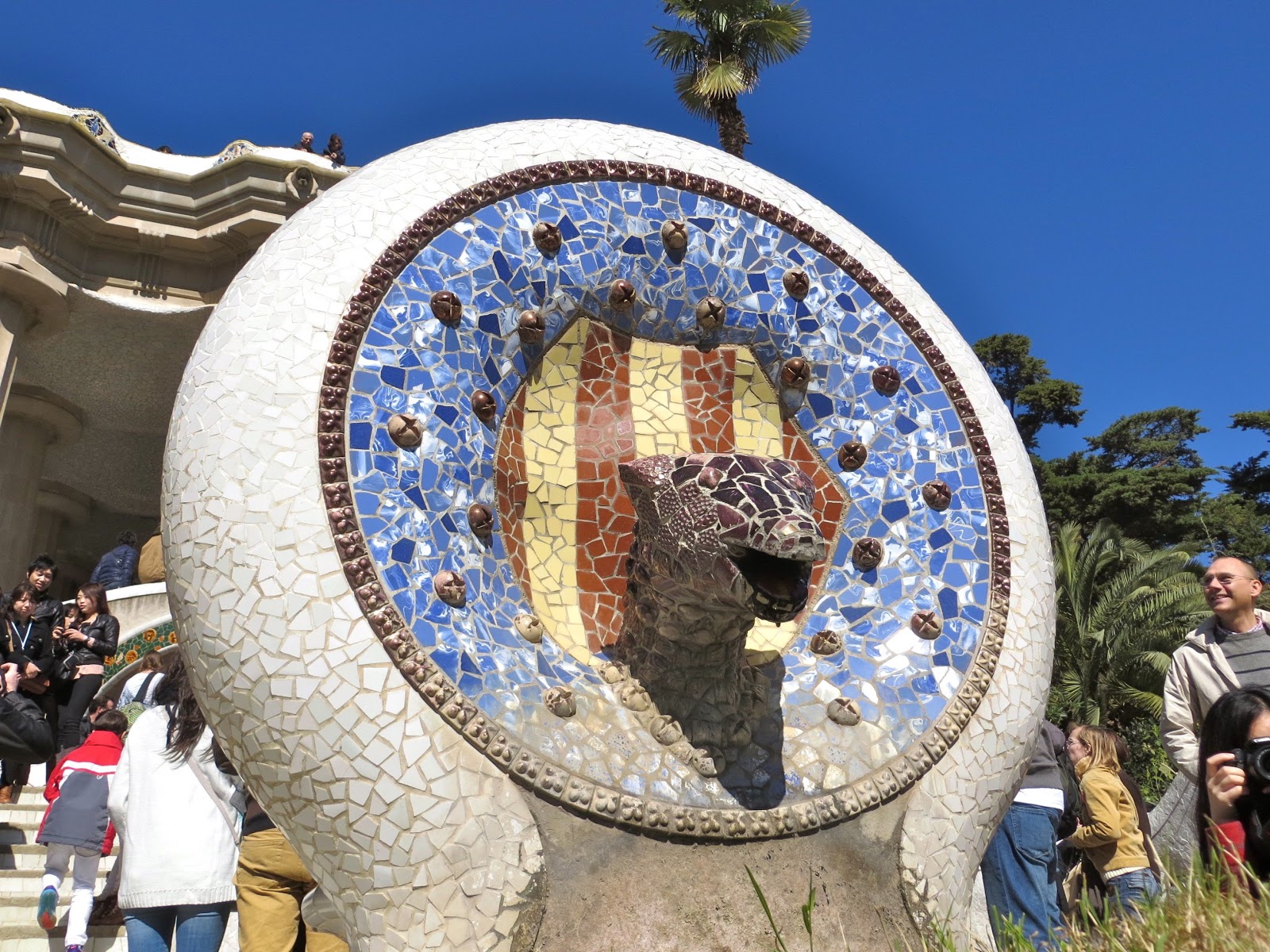
Candyland or Park Guell?
Gaudi's influence in Barcelona extends even further than the Sagrada Familia, though.  His distinctive style can be seen in various buildings around town, as well as in Park Guell (pronounced like "Parkway").

Park Guell is situated on a hill on the north side of town.  It was designated as a park space after a planned community project failed.  Before visiting the Sagrada Familia, Tom and I made the pleasant (but uphill) walk over to the park to enjoy its funky Candyland-esque design and to take in the fabulous views of the sea and the city.  The Park was extremely crowded with groups of school children and Swiss tourists (the latter of which wore matching hot green vests and carried hiking poles), but as we climbed higher and higher on the park's many stairways, the tourists did become a bit less numerous.  Unfortunately all of the people made it feel a bit more like a theme park than a nature experience, but we did enjoy visiting such a unique place.

Park Guell
Park Guell

Gaudi Architecture
At other points in our trip, we also had a lot of fun just looking for (and then looking up at) Gaudi's other colorful and whimsical buildings around town (which are incredibly easy to pick out of a lineup). Often they inspire comparisons to food, nature, or the types of themes you might find at a ten year old's birthday party such as "under the sea."  

Even apart from Gaudi, though, Barcelona is generally known for its architecture for good reason.  It really seems like many of the buildings there are more creative and innovative than those in many other parts of the world, and Barcelonians don't seem to have any qualms of mixing drastically different styles of architecture in the same area.  In the end, though, it really works to create an interesting, eclectic urban environment.    

3.  Biking Along the Coast

"Biking" (with the kickstand down, apparently)
On the second day of our trip, Tom and I rented bikes and spent half a day riding north along the sunny coast.

It's funny, after spending our first day and half entirely in the city, I had almost forgotten that Barcelona was on the sea, but once we went just a half mile or so in the opposite direction from our vacation apartment, the scenery completely changed.  Suddenly, instead of small windy streets and Gothic buildings we saw sandy beaches, tons of boats (mostly docked, since it was still a bit chilly for sailing), and bikers, rollerbladers (that sport is still big in Spain, apparently), and joggers galore.  

Downtown
We also rode past the more commercial/downtown center of Barcelona, which many office workers commute to every day.  Here, too, the architecture was especially unique and interesting, and it seemed like we were stopping every few minutes just to take in all of the views.

The highlight of this day, though (possibly the highlight of the whole trip for Tom), was  our discovery of some adult-sized playground equipment along the coast (or, at least, if it wasn't intended for adults, then Barcelonians must really not worry about child safety the way Americans do). Tom and I had a blast climbing up the twenty (or so) foot roped structure and then sliding down the (very fast) slide, before running back to climb up again.  Someone really needs to develop spots like that in the Midwest.  (I guess I'll have to keep that in mind for when the whole lawyering thing gets old.)

A Chilly Day at the Beach
It's true that one general criticism of Barcelona may be that it's a bit lacking in green space.  For a city of its size, the parks are limited (and crowded), and many areas that appear "green" on the map are really just open squares filled with gravel. However, the extensive trail system along the coast does help make up for this, and you do have to hand it to Barcelona for creating many opportunities to get additional exercise (on various pieces of public play and exercise equipment) along the way.

It was much too cold to contemplate a dip in the water, but we did enjoy the fact that the beaches were less crowded than they otherwise would have been.  I have rarely rented a bike when on vacation, but I really think it's something I should be doing more often.  It's such a great way to see a lot more of the city in a limited amount of time.

4.  Montjuic

Olympic Stadium
On our last day, Tom and I hiked up to Montjuic, a hilly area on the west side of town.  Over the years, Barcelona has used this area to hold world-class events, most notably the 1929 World's Fair, and, more recently, the 1992 Summer Olympics.  The area is also home to several museums (none of which we had time to visit, unfortunately), including the National Art Museum of Catalonia.

It was a lot of fun to wander around the Olympic Park and imagine what it must have been like filled with athletes and spectators in '92.  The main square was quite beautiful and contained several water features, as well as the communications tower (which apparently also functions as a sundial).  If I lived in Barcelona, I'd totally run around that area while blasting the "Rocky" theme song on my iPod.  In other ways, though, it was a bit depressing to see that there is now little purpose for much of the space. Much of it seems to regularly sit unused, and some of the facilities are quite neglected.  (As a sad example,  we saw lots of trash floating around the diving pools.)  But, on the whole, our experience there was still a positive one.

Olympic Square

We definitely saved the best for last, though, because the area around the National Art Museum was really spectacular.  The Museum building itself was beautiful, and from it, there were sweeping views to the north of the city.  Unfortunately the large fountain at the bottom of the hill wasn't yet turned on  for the season, but we didn't miss it much with so much else to see.

View from National Art Museum
National Art Museum

Of course, over the course of our trip, we did lots of other fun things, including exploring different neighborhoods, checking out the local markets, visiting other (less grand but still beautiful) churches, and eating tons of delicious non-Italian food.  We also had the opportunity to meet up with an old friend (who just happened to also be vacationing in Barcelona), as well as a family friend (who lives there).  All in all, we had a completely amazing time and already can't wait to go back in 2026 (or whenever they finally finish that crazy church)!

Alla Prossima,
Erin

-------
Sat. Mar 23:  The weather in Barcelona was similar to how it's been in Rome.  Party cloudy, highs around 60, but still cold enough at times to need a coat of some sort.

Thursday, March 14, 2013

Habemus Papam! ("We have a Pope!")

If you had told me ten years ago that I'd be living in Rome in 2013, I'd be surprised, but probably not completely incredulous.  I love travel, fancy myself as somewhat adventurous, and have always wanted to spend some time living abroad.  Despite, this, though, if you had told me that I'd someday be in St. Peter's square for the announcement of a new Pope, I'd never believe you.  I  mean, there have only been three popes in the last thirty five years.  What are the chances?  

Holy Smokes, It's White! (photo from National Geographic)
But we were here!  And it was amazing.  So amazing, in fact, that I wasn't able to wind down and go to sleep until about 2 AM. Here's how it all went down:   

Around 7 PM (after the fourth and final vote of the day), Tom saw white smoke coming out of the chimney on the roof of the Sistine Chapel.  Well, more accurately, he watched it happening live online, got super excited, called me (from his office), and then sent an email out (in Latin, of course) to everyone at the Academy.  He then raced back to our room, where we grabbed our raincoats and umbrellas, and less than five minutes after the smoke appeared, we found ourselves speed-walking with two of our friends down to Saint Peter's Square.  

The Square is only about a 20-25 minute walk from the Academy if you know the "secret way," which involves following the narrow road that runs along the Aurelian Wall.  It was already dark out and sprinkling a bit, but the walk went fast, and we spent the time guessing who the new Pope would be and what name he'd take.  (For the record, none of us guessed correctly.)  Even though we were walking about as fast as we could, we still were passed by several people who were literally running down to the Square in hopes of making it in time to get a good spot and see the new Pope.  

Areal Shot of St. Peter's Square (this photo is a photo of the video screen)
As our friend, Lauren, noted, though, it was very much a "hurry up and wait" sort of situation, because once we got down to the Vatican, not much was actually happening yet.  Still, it was really amazing to just to be in St. Peter's Square for such a momentous occasion.  It took us several minutes to get in (since guards had our normal entrance blocked off), but once we made our way through, it was actually less crowded than we were anticipating.  The rain also had stopped, so we found ourselves a nice spot in the middle of the Square with a view of the Basilica and one of the giant video screens.  We took a few pictures, and then the waiting began.  

The atmosphere was a strange one-  sort of a mix between solemn reflection and pure celebration (the celebration part being almost like how people react after their home team wins the World Series or the Superbowl).  People were smiling, and shouting and laughing, and others were quietly praying.  It was also crazy to see so many cameras.  Anywhere you looked, there literally hundreds of flashes going off at any given moment.  I wasn't lucky enough to attend Obama's first inauguration myself, but our friends who had been there likened this experience to that one.    

Waiting for the Pope!
I have to say that it seemed like that the Vatican unnecessarily drew out the process, but that's probably just because I was excited.  I suppose that an hour isn't actually that much time for the newly elected Pope to choose a name, think about what he'll say to the crowd, and get dressed. (Apparently, once a conclave starts the Vatican commissions new Papal garments in sizes S/M/L and also keeps various sizes of red shoes on hand so the new Pope will have something to wear, whatever his stature.)  Of course, I like to imagine that the new Pope might also need a few minutes to do some positive affirmations in the mirror (you know, to pump himself up by saying things like "You're the freaking Pope!  You're charming and smart and God's right hand man!  You've got this!") before addressing millions of people around the world.  And then, finally, he and the rest of the Cardinals have to make their way up to the second floor of the Basilica.    

The Crowd Waits (with cameras in hand)
About ten minutes in, we saw the lights come on on that second floor, and the crowd went wild, but it was a false alarm, because no one appeared on the balcony at that point.  After another ten minutes or so, though, the Cardinal Protodeacon came out and announced "Habemus Papam" (a latin phrase, which means "we have a Pope") to the crowd, and they hung the official cloth from the balcony on which the Pope would soon appear.  Everyone went absolutely wild.  The Cardinal also announced the new Pope's birth name (Jorge Mario Bergoglio), as well as his new chosen name (Francesco), and then retreated back into the Basilica.   

At this point, a wave of confusion spread over the crowd.  Everyone was saying, "who?" and  "from where?" and looking to the strangers around them to provide answers.  Since the media had never identified Bergoglio as a front runner, very few people had any idea of who he was.  Luckily, though, since we live in a modern age, almost everyone around us had smart phones, and so we were able to quickly learn that Francesco hailed from Argentina.  If any of the Italians in the crowd were bitter about this, they certainly didn't show it, although it may have helped that Francesco's parents were both Italian (so that many Italians can still consider Francesco a native).  

Habemus Papam!
Finally, after a lot more waiting, around 8:30 the newly elected Pope made his way onto the Balcony.  This time, people went absolutely nuts, and started chanting Fran-ces-co, Fran-ces-co over and over! Once he started speaking, though, a hush fell over the crowd.  His address was very brief.  He basically greeted the crowd, stated (a bit oddly, in the third person), that he was the new Pope, said a prayer for Benedict XVI, and then talked about a "road of brotherhood" going forward in the Church.  Finally, he blessed everyone.  The whole thing was probably only about five minutes long, but, since his Italian accent is quite a bit better than Benedict's, we were actually able to understand bits and pieces of it!    

Franceso!  (photo of video screen)
Once it was over, we high-tailed it out of there, for fear of getting "stuck" for hours in the crowd.  On our walk home, we were passed by a few cars, who would honk and shout things like "Francesco!" or "Viva il Papa" from their windows.  I think there is a lot of hope and excitement that the new Pope can lead the Church in a more positive direction following all of the recent scandals, so it will be interesting to see how that plays out.  

Perhaps due to divine providence, our dinner at the Academy had been moved from its normal 8:00 time to 9:00 (to accommodate an art show), so we were even able to make it back in time to eat, and swap stories with the other fellows.    

Like I mentioned previously, it took me a long time to wind down from the experience.  That might sound silly, since I'm not Catholic (and since I also actually strongly disagree with many of the Church's official views and policies), but it was really one of those times where it seemed much better and more appropriate to let myself get excited about others' excitement and the historic nature of the event rather than taking a cynical or political view of it all.  And, actually, I'm sure that someday when I'm an old lady I'll still be telling the story of how I once saw the announcement of a new Pope (you know, while drinking lemonade in a rocking chair on my front porch- somehow with a southern accent).

Alla Prossima,
Erin 

-------
Thus. March 14:  Yesterday was a rainy and smoky day in the Vatican:  first black smoke (around 11:40 AM), then white smoke (at 7 PM).  

Thursday, March 7, 2013

The (Pope-less) Vatican

St. Peter's Square from Above (stock photo)
It's an exciting time to be living in Rome.

In case you've been living in a cave for the past few weeks, Pope Benedict XVI resigned on February 28th, marking the first time any Pope had done so since 1415.  Unsurprisingly, this event has stirred up a lot of excitement here in Rome (and all around the world).  Although there's been a huge media presence outside the Vatican, little is still known about several major issues such as (1) why did the Pope resign?  (2) when will a new Pope be chosen? and (3) who will be the new Pope?

Of course, that hasn't stopped nearly everyone from speculating on the answers.

Pope Benedict XVI Giving a Sunday Address (back in October)

As to the first question, the official reason given by Benedict for his resignation was his deteriorating strength in "body and mind."  This seems fairly plausible, given his advanced age (85), until you consider that none of the Popes over the last 600 years let their deteriorating health stop them (and, in fact, Gregory XII, who was the last Pope to resign, in 1415, only did so to end a debate as to who was the rightful claimant to the Papacy).   

Italian Vanity Fair Cover
Given this, there are now many theories/rumors in circulation as to the "real" reason for his resignation, including that Benedict had no real power and that attempts to get the Vatican bank out from under Mafia control were thwarted by his second in command, and that Benedict's involvement in covering up sex scandals ("gay sex rings" between priests) will soon come to light.

Some are also speculating that Benedict is involved in a gay relationship himself (although, even if true, it's not entirely clear if that would have played into his resignation decision).  This last rumor has mostly come out of the fact that Benedict (who now holds the title "Pope Emeritus") will continue to live in the Vatican with his (much younger and very attractive) secretary, Georg Ganswein.  As a hilarious side note, Italian Vanity fair recently ran an article about Ganswein using the headline "it's not a sin to be beautiful," and calling him the "George Clooney of St. Peter's." 

In any case, whatever the real reason, I imagine that many will continue debating it for a long time to come.  

Trio of Nuns Being Interviewed by Media
Unfortunately, the answer to the second question, when the new Pope will be selected, isn't any more clear than the first. Generally speaking, a Pope is chosen in closed meeting of the cardinals called a "conclave."  This meeting takes place in the Sistine Chapel, often over the course of a few days.  All Cardinals under  the age of 80 vote (the idea being that the older ones are somehow "too old"), and  the Cardinal ultimately receiving 2/3 plus one of these votes (which normally takes several votes) is elected the new Pope.

Normally, a conclave starts 14 days after the death of the last Pope (to allow time for grieving and for Cardinals to travel to Rome), but in this case, the timeline was a bit less clear since Benedict announced his resignation in advance.  The rules were changed to allow a conclave to start earlier than the 14 days, and the Cardinals have held meetings to decide when the conclave should start, but as of yet, it has not started, and no date has been announced.  In any case, at the very least,  I'm betting on a new Pope by Easter.  

View of St. Peter's Through the Famed Keyhole"
As to the third question, the media (and Vegas- yes, you can actually put money on the next Pope!) has identified several front-runners, but since the cardinals are sworn to secrecy, it's really anyone's guess who the next Pope will be. However, names that often get thrown around are Marc Ouellet (of Quebec), Peter Turkson (of Ghana), Antonio Tagel (of the Philippines), and Angelo Scola (of Milan).  Choosing a non-European (and possibly even non-white) Pope would be a huge departure for the Catholic Church, but I expect that many Cardinals believe now is the right time.  In any case, I imagine there will be some lively debates.

So, how will we know when the new Pope is elected?  By watching for the smoke signal, of course!  Every time the Cardinals vote, the ballots are burned.  Black smoke indicates that no pope was elected, but when the white smoke comes, you better believe that everyone in the city will be running down to the Vatican- including us if we're in town!

It's true that as a non-Catholic, I don't really feel any personal or spiritual connection to the Papacy, but, from a historical perspective, it's still a very exciting event to be present for.        

In St. Peter's Square
And, regardless of your religious convictions, the Vatican really is a beautiful and interesting place to visit (new Pope or not).  St. Peter's Cathedral is truly part of the Roman landscape, since it can be seen from many parts of the city, but it's grandeur is best appreciated from St. Peter's Square.  The Square also contains two fountains and a obelisk, as well as massive amounts of tourists (and locals) who pass through every day.

Nearby you can also find items to fit all of your Vatican/Pope memorabilia needs, such as the ever-popular Popener (Pope themed bottle opener) or the 2013 Hot Priests Calendar (yes, seriously).

On Sundays, the Pope (when there is one!) gives a Sunday address and on those days the Square is literally packed with people (you sometimes have to elbow your way out afterward), many of whom hold signs or flags and cry and/or cheer when the Pope begins speaking in their own native language.  (He reads the address in about six different ones- Italian, French, Spanish, German, English, and Polish.) 

From the Hall of Maps
You could also spend days inside the Vatican museum, which houses the Vatican's huge collection of art, including Renaissance paintings, ancient sculpture, and other themed rooms that are difficult to explain like the Hall of Maps.   Much like the name indicates, this Hall is a hallway filled with historical maps of Italy and the surrounding region.  (My bizarre love of looking at maps coupled with the beautiful ceiling actually made this my favorite room at the Vatican.)

Of course, the Vatican is also home to my second favorite room (sorry,  but the maps win out!), the Sistine Chapel, which was painted by Michelangelo in the 1500s.  You can't take any pictures in the Chapel (or really talk without being shhh-ed by the guards), but there's so much to take in that no one seems to mind (although I did mind the crink I had in my neck after staring at the beautiful ceiling for twenty or so minutes!).  Incidentally, Tom, his parents (Diane and Jerry), and I just happened to visit the Sistine Chapel the day before they closed it down in anticipation of the conclave, which was pretty lucky (since it will be closed for a couple of weeks now, I imagine).      

Stock Photo of the Sistine Chapel

I realize this post is getting ridiculously long, but I really could go on and on about all of the adventures Tom and I have had in or near the Vatican, including trying out our (now) favorite Roman sandwich shop, and the time I got locked in the Vatican bathroom (I'm not exaggerating- they had to call the fire department to take the door down).  But perhaps I can tell you more about those experiences next time- once we have a new Pope!

Alla Prossima,
Erin 

------
Thurs. March 7:  It's warmer (highs around 60) but rainy and windy.